


ECHOES OF THE PAST
Where history walks beside you wherever you go.
Dive into the historical events, movements, and freedom fighters linked to the city.

Subhas Chandra Bose
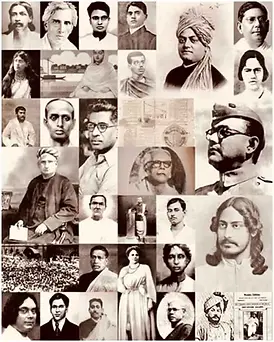
The heartbeat of Bengal’s revolutionary zeal, Netaji Subhas Chandra Bose stood as an uncompromising leader who dared to dream of complete independence at a time when moderation prevailed. Born in Cuttack but nurtured by Calcutta’s revolutionary air, Bose rose from being a brilliant student to the charismatic President of the Indian National Congress, before breaking away to forge his own radical path. With his resounding call “Give me blood, and I will give you freedom”, he mobilized countless Indians to rise beyond fear. His creation of the Indian National Army (INA) turned Bengal into the ground from which freedom’s flames roared, inspiring generations to see liberty as not just a hope, but a right to be seized.

RAJA RAM MOHAN ROY
The dawn of modern Bengal cannot be imagined without Raja Ram Mohan Roy. Called the “Father of the Indian Renaissance,” he waged an unrelenting battle against social evils such as sati, superstition, and blind orthodoxy. With rare foresight, he championed women’s rights, education, freedom of the press, and the spirit of reason. His founding of the Brahmo Samaj laid the foundation for religious and social reform that swept across Bengal, making Kolkata a cradle of progressive thought. His voice blended tradition with modernity, creating the intellectual soil from which India’s future leaders would bloom. It was his persistent advocacy that led to the abolition of sati in 1829 by Lord William Bentinck.

Ishwar Chandra Vidyasagar
The very embodiment of Bengal’s Renaissance spirit, Vidyasagar was more than a scholar—he was a reformer, a humanist, a social revolutionary. With his unmatched command of Sanskrit and his simple, compassionate Bengali prose, he opened the doors of education to all, particularly women, who had long been denied its light. His fearless advocacy for widow remarriage and his campaign against child marriage shook orthodox society, yet he stood unyielding in his conviction that humanity must triumph over superstition. Bengal remembers him not just as a scholar, but as a fatherly figure whose intellect and compassion reshaped society forever.

KHUDIRAM BOSE
The story of Khudiram is the story of youth set ablaze with the fire of freedom. At merely 18 years of age, he became one of the youngest martyrs of India’s independence struggle, with a smile and a fearless spirit. His attempt to strike down the British with a bomb was more than an act of rebellion—it was a thunderous declaration that the youth of Bengal would no longer bow to chains. His sacrifice ignited courage across the nation, reminding India that freedom demanded not just words, but lives laid down with unflinching resolve. His cry of “Vande Mataram” echoed through the gallows, sealing his place as a timeless symbol of youthful defiance.

AUROBINDO GHOSH
Aurobindo’s journey was one of profound transformation—from fiery revolutionary to enlightened yogi and philosopher. In his early years in Bengal, he was at the forefront of the nationalist struggle, urging Indians to rise boldly against colonial power. Arrested and imprisoned in Alipore Jail, his spiritual awakening began amidst the walls meant to silence him. Later, as a seer and thinker, he fused nationalism with spiritual vision, giving Bengal—and India—an enduring philosophy of integral growth. His writings inspired countless freedom fighters, while his deeper message lifted the movement beyond politics into a vision of human evolution.

BAGHA JATIN
Known as Bagha Jatin for his legendary feat of wrestling a tiger with nothing but a dagger, Jatindranath Mukherjee embodied Bengal’s fierce revolutionary spirit. A leader of the Jugantar party, he believed that independence could not be begged for but had to be seized with force and sacrifice. His daring plan to arm Indians with German weapons during World War I became one of the most audacious attempts to overthrow British rule. Mortally wounded in the Battle of Balasore, he fought valiantly to his last breath. Bagha Jatin became a symbol of Bengal’s raw courage and the indomitable will to fight until the very end.